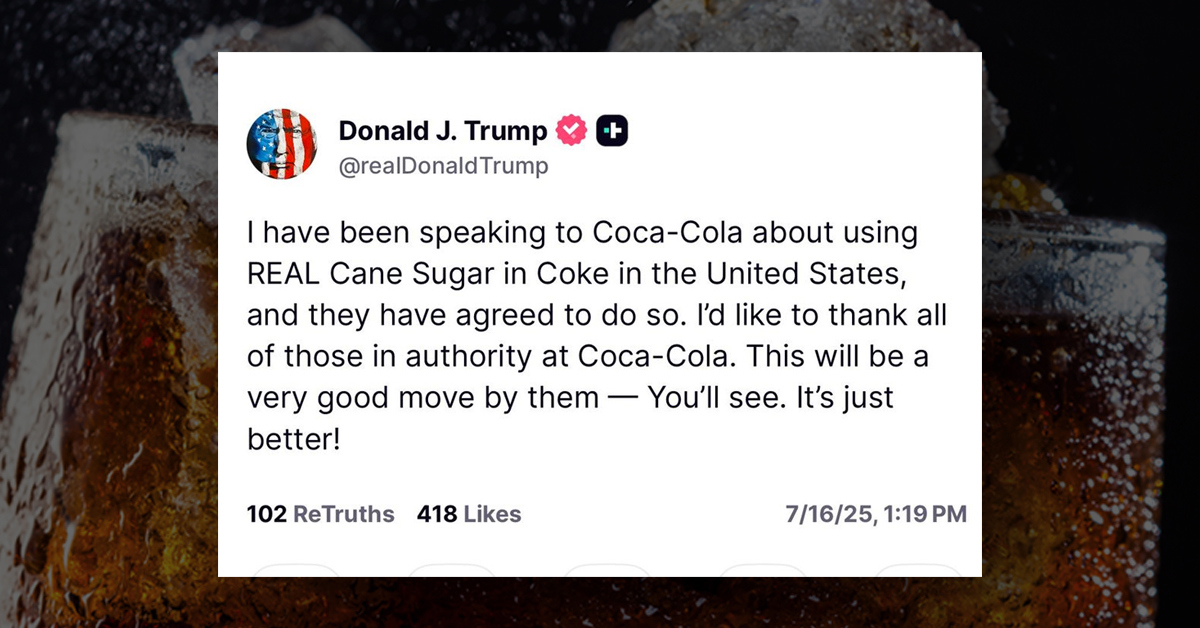
Donald Trump put The Coca-Cola Company on the spot Wednesday afternoon when he posted that he’d spoken with them and claimed they agreed to use real cane sugar in name brand Coke again, instead of high fructose corn syrup (HFCS). “It’ll be a very good move – You’ll see. It’s just better!” the President wrote. But before clean ingredient advocates – or just plain original recipe lovers – get too excited, Coke’s reaction seemed to be less than complete adherence. The company opted to neither confirm nor deny the shift to real sugar in a statement that came roughly two hours after Trump’s late afternoon proclamation. While we can’t know what’s in James Quincey’s heart, it didn’t sound to us like the response of a business all gung ho and ready to reformulate its leading multi-billion dollar brand. “We appreciate President Trump’s enthusiasm for our iconic Coca‑Cola brand,” the company wrote. “More details on new innovative offerings within our Coca‑Cola product range will be shared soon.” Even if this change doesn’t come to pass, we do have questions around what it might look like. For one, how does the Trump administration’s Make America Healthy Again initiative play with the president’s single-minded focus on high flat tariffs as an economic policy? The vast bulk of HFCS is manufactured domestically thanks to corn-growing states (here’s looking at Iowa), but the USDA reported that as of December 2024 only 55% of raw sugar was domestic while 37% is imported. Although we should note total raw sugar imports were down year-over-year. It’s likely any switch would lead to price increases: HFCS costs about $0.20-$0.30 per pound vs. $0.40-$0.50 for cane sugar, according to ByteBridge. From a production standpoint, the conversion would involve up-front costs to warehouse sugar and likely require more frequent servicing of some equipment - sugar is less stable than HFCS, according to an ops expert we spoke with - but the recipe would not change much. There’s also the possibility that Coke could simply expand the availability of its full-sugar products, which are sold in limited distribution in the U.S., perhaps with a branded line of its own similar to its main competitor’s experiment with Pepsi Real Sugar. One thing that’s probably not in the cards, however, given Trump’s obsession with nominative sovereignty: wider use of the term “Mexican Coke.” 🆓 Read the story on BevNET for a complete look at what we know so far. |