| | | | | | In today’s issue | 🦭 Smuttynose Parent Acquires Five Boroughs • 🎯 Bart Watson: Craft Market Has ‘Matured’ • 💰 Tree House Flagship Brewery's Economic Impact • 👱♂️ Beer Institute Names New Chief Economist • 📉 CGA: On-Premise Spirits Volume -3.3% • 📊 Data Dive: Circana Weekly Numbers • 🎄 New on Shelves: Mad Elf Grand Cru |
|  | | | Sponsored message from First Key Consulting | To be a successful contract brewer you need to consider the future possibilities…and current realities. Keys to success include knowing your costs, getting the team’s input and buy-in, defining your customer service plan, establishing quality specifications, and establishing a good contract.
Learn more
|
| Today's Top Story | | | Finestkind Brewing, the parent company of New Hampshire’s Smuttynose Brewing Co., has acquired Brooklyn, New York-based Five Boroughs Brewing Co. Financial details of the transaction were not disclosed. The deal closed on October 23 and was announced to employees at both breweries Tuesday afternoon. In the coming months, Five Boroughs’ production will be shifted to Smuttynose’s facility in Hampton, New Hampshire. However, Five Boroughs will maintain its taproom in the Sunset Park neighborhood of Brooklyn as an innovation-focused hub for small-batch beers. Finestkind is also open to further expansion as a geographically diverse beverage platform. In addition to Smuttynose, Finestkind’s portfolio of brands includes spirits-based, ready-to-drink Island District Cocktails. The company is also exploring expansion into non-alcoholic offerings. Finestkind CEO Steve Kierstead said: “We do have a large appetite for more M&A – we have additional capacity that is not utilized. In the short term, the focus is to really make sure that we're doing right by Five Boroughs and focusing on the brand Five Boroughs and learning the brand and long term growing the brand, but we do have a big appetite for building a platform.” Kierstead praised Five Boroughs’ ability to zero in on its key offerings with minimal distractions. Kierstead said: “They've done a tremendous job with the brands that they have and their core is really strong. They don't have this big wide portfolio and a long tail, and I think there's something to be said about that – the consumer is very, very engaged with their brand and, for the most part, with their core.” As the companies merge, the Smuttynose portfolio will move into S.K.I. Beer’s warehouse, which is Five Boroughs’ largest distributor and covers most of New York City (except for Staten Island), Long Island, and Rockland, Westchester, Putnam and Dutchess counties. Other than that, the only wholesaler the brands share is Remarkable Liquids in New Jersey. There are no current plans to bring Five Boroughs’ products beyond its three-state footprint of New York, New Jersey and Connecticut, Kierstead said. Kierstead said: “At this point, the strategy is not to take the brand and go into seven new states. I'm a big believer in going deeper rather than wider.” Brewbound Insiders can read more about the deal, including comments from Five Boroughs co-founder and CEO Blake Tomnitz and Finestkind CEO Kierstead. |
| | From the Wire | | | | Photo by Josh Souza Photography, courtesy of the Mass Brewers Guild | The demand for craft beer isn’t growing anymore, and craft has officially become a mature – not maturing – market, Brewers Association (BA) chief economist Bart Watson told industry members Monday at the Massachusetts Brewers Guild’s Technical Brewing and Business Conference, held at Jack’s Abby in Framingham, Massachusetts. Watson likened the change in the marketplace to playing darts. During craft beer’s peak, when craft brewery openings significantly outpaced closings, if you threw a dart – whether that dart was a new brewery location or product innovation – “you probably hit a bullseye,” Watson said. Now, with a mature market, brewers have to “be focused” and “really know what you’re doing” to find the target, i.e. success. Watson said: “Demand just isn’t growing anymore. Craft used to be growing by leaps and bounds and there was a world where we can grow 18% of an industry, [and] that was enough growth for everybody, the pie was just growing much faster. Today, that's not true anymore.” Now, brewers must continue to accept smaller and smaller pieces of a collective pie. Or, the industry must work together to grow that pie with new occasions and innovation, Watson said. Insiders can read more, including Watson’s comments and numbers on craft’s challenges with pricing, demographic changes and increased competition. |
| | | | Tree House Brewing Company’s flagship location in Charlton, Massachusetts, generates $60 million annually in economic impact, according to a study by the Donahue Institute at the University of Massachusetts. Since its opening in 2017, the Charlton facility has generated $483 million in cumulative economic impact, the study found. The brewery employs 185 workers at its Charlton location. With the addition of “jobs that are indirectly created through the company’s external spending,” Tree House’s total employment increases to 240, according to the study. The brewery wrote on LinkedIn: “Tree House is far more than that brewery your cousin won’t stop talking about – it’s an engine of economic vitality within our communities and a force of opportunity for individuals and businesses we share space with. “We take this stature very seriously, and we are committed to remaining a strong, diverse business that continually reinvests any successes back into our locations to build a stronger future, provide new job opportunities, bolster local economies, and curate vibrant shared community spaces for all to enjoy.” Similar data about the brewery’s locations in Sandwich, South Deerfield and Tewksbury, Massachusetts are scheduled to follow in the next few weeks, Tree House said. Last month, Tree House announced plans to open a brewery in Saratoga Springs, New York, in 2024. Tree House was the No. 61 largest regional craft brewery by volume in the country in 2022, as well as the largest taproom in the Northeast, according to the Brewers Association (BA). The company produced 44,000 barrels of beer in 2022, a +10% increase versus 2021. |
| | People Moves | | | The Beer Institute (BI) has hired Andrew Heritage as its new chief economist, filling the data head vacancy left by Danelle Kosmal. Kosmal announced her plans to depart her role as BI VP of research in July after nearly two years with the trade association. Kosmal and her family are moving to Japan in December for a two- to three-year stay. However, she will remain a part of the industry as a consultant for 3 Tier Beverages, a Chicago-based beverage-alcohol consulting and data firm. Heritage previously worked as the senior economist at the Coalition for a Prosperous America (CPA), a national non-profit organization representing multi-sector manufacturers, workers, farmers and ranchers in the U.S. Prior to CPA, Heritage was the lead economist at Thumbtack, a home services website, and a senior policy analyst at the National Federation of Independent Business (NFIB), according to a press release. Heritage said in the release: “I’m excited to bring together my love for beer and economics as I lead the Beer Institute’s research efforts and help tell the story of this wonderful beverage.” Insiders can read more from Heritage, as well as comments from BI president and CEO Brian Crawford. |
| | Data Dive | | | Rising prices and a slight dip in guest traffic have contributed to falling spirits sales in the on-premise channel over the last year, according to a new report from market research firm NIQ’s on-premise data arm CGA. On-premise spirit sales by volume dropped -3.3% on-premise in the last 52-weeks through early September, reported CGA. Prices of 1.5 oz spirit pours have risen by an average of +4.8% from the previous 52-week period, generating a +1.4% increase in sales by dollar value. With consumers feeling the squeeze, value and mid-range spirits recorded the biggest drops in sales by volume over the last year, down by -8.6% and -6.4%, respectively, compared to the same period last year. But sales of premium and super-premium spirits both fell by less than -1%, while the ultra category grew by +3.5%. BevNET spirits editor Ferron Salniker has more. |
| | | | Total bev-alc dollar sales increased +1.2% year-over-year (YoY) and +3% week-over-week (WoW) in the latest week, ending October 29, according to Circana’s Scott Scanlon in the data firm’s weekly scans update. In the last 52 weeks, bev-alc dollar sales are up +2.8%, while volume is down -2.3%. Scanlon wrote: “All categories gained for the third week in a row and believe we will see slight continued benefit of Halloween roll into next week’s data release. “Continue to believe we could see retracement in the data prior to holiday Thanksgiving strength.” Beer dollar sales increased +1.3% YoY in the latest week, while volume was down -0.5%. In the last 52 weeks, beer dollar sales increased +2.9% and volume declined -2.5%. Constellation Brands’ Modelo continues to post double-digit dollar sales growth, including a +22.8% YoY increase in the latest week. However, Anheuser-Busch InBev has reclaimed the No. 1 spot for most dollar sales, despite a -21.6% YoY decline. Boston Beer Company’s Twisted Tea (+27.8% YoY) and Molson Coors’ Simply Spiked (+48.9%) also posted significant gains leading into Halloween weekend. |
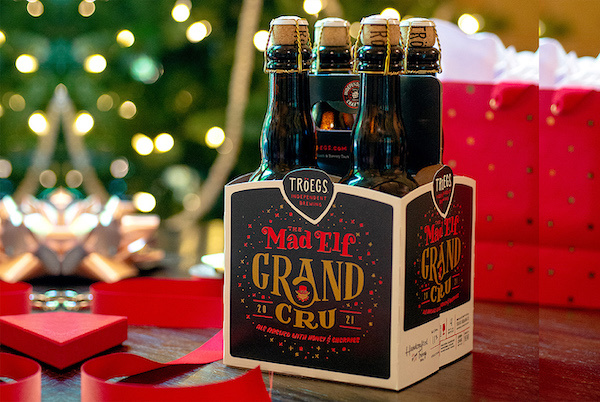
| | New on Shelves | | | Tröegs Mad Elf Grand Cru has returned to kick off the holiday season, the Hershey, Pennsylvania-based brewery announced last week. The Belgian-inspired ale (11% ABV) is brewed with chocolate, Munich and pilsner malts and Pennsylvania wildflower honey. Both Mad Elf and Mad Elf Grand Cru use the same aforementioned ingredients, as well as Belgian yeast for “flavors of cinnamon, clove and allspice,” according to a press release. Where the beers diverge is their cherry content. While Mad Elf uses five cherry varieties (Bing, Lambert, Van, Royal Ann, and Montmorency, according to the brewery’s website), Mad Elf Grand Cru focuses solely on Balaton cherries, which “impart notes of tart pie filling,” according to the release. Mad Elf Grand Cru is available on draft and in corked and caged 375 mL bottles. |
| | Save the Date | | | Leaders from Bell’s Brewery, Rogue Ales & Spirits and CANarchy will share strategies on reinvigorating flagship offerings during the 2023 Brewbound Live business conference December 6 + 7 in Marina del Rey, California. Bell’s EVP Carrie Yunker, Rogue president Steven Garrett and CANarchy chief commercial officer Chris Russell will explore brand building strategies, how to leverage brand equity of longstanding flagships, considerations for creating brand families and how to create a halo effect across your portfolio. Bell’s has built out its Two Hearted IPA and Oberon brand families with line extensions this year. Rogue has transformed Dead Guy into a family across several styles. And CANarchy has leveraged the Dale’s brand family, while also launching a marketing campaign for Cigar City’s Jai Alai. Brewbound Live takes place December 6 + 7 at the Marina del Rey Marriott Hotel (4100 Admiralty Way, Marina Del Rey, CA). Tickets are available now. |
| | Now Hiring | | | | | |
| Your BevNET CPG Media Subscriptions You're currently subscribed to newsletters from BevNET CPG Media. To change which newsletters you receive, update your preferences - don't miss out on topics you care about. | |
| |
|
| | | |
|